Save the Date Template Printable Wedding: A Practical Review
In the crowded landscape of wedding planning resources, finding a digital asset that balances professional aesthetics with genuine usability is often a challenge. Many couples and planners settle for generic designs that require extensive graphic design knowledge to modify or pay premium prices for services they could easily handle themselves. The Save the Date Template Printable Wedding emerges as a notable exception to this trend. It is not merely a static image; it is a comprehensive suite of editable files designed to streamline the initial phase of wedding communication while maintaining high visual standards.
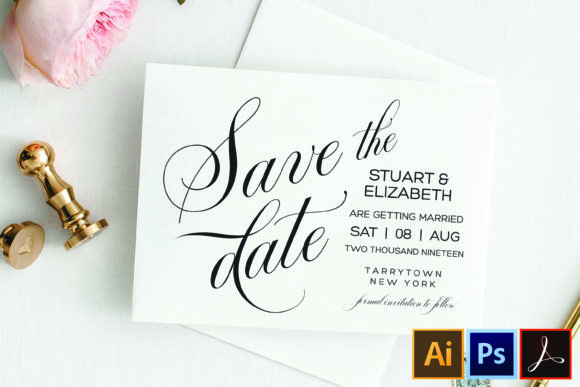
This template distinguishes itself through its multi-format availability, catering to users who operate across different software ecosystems. Whether you are a freelancer comfortable with vector manipulation in Adobe Illustrator, a designer relying on Photoshop's layer capabilities, or someone who prefers the straightforward accessibility of PDF editing, this package offers a solution. The core value proposition lies in its flexibility. By providing three distinct file types—Adobe PDF, Adobe Photoshop (PSD), and Adobe Illustrator (AI)—it removes the friction often associated with customizing print-ready materials.
Understanding the Format Versatility
The decision to offer the Save the Date Template Printable Wedding in multiple formats is a strategic one that addresses diverse technical workflows. In a practical setting, the choice of format often dictates the efficiency of the design process. The 5"x7" dimensions provided are standard for invitation suites, ensuring compatibility with most home printers and professional printing houses without requiring complex scaling adjustments.
For users working within the Adobe ecosystem, the distinction between the PSD and AI versions is significant. The Adobe Photoshop version allows for pixel-based editing, which is ideal if your workflow involves heavy image manipulation or if you need to integrate complex raster effects. Conversely, the Adobe Illustrator version utilizes fully editable vectors. This means that lines, shapes, and graphical elements can be resized infinitely without losing resolution. For a wedding invitation that needs to look crisp at various print sizes or when viewed on high-resolution screens, the vector capability of the AI and EPS formats is a critical feature.
The inclusion of the Adobe PDF format adds another layer of utility. While less flexible than the native application files, a well-structured PDF allows for quick text updates using standard readers or lighter editing tools. This is particularly useful for non-designers who need to make rapid changes to dates or names without opening a full graphics suite. The fact that all graphics and design elements inside the project file are fully editable vectors, rather than locked images, ensures consistency across all three formats. You are not just editing text; you have the freedom to adjust colors, reposition vectors, and modify layout elements directly.
Usability and Design Flexibility
Evaluating the usability of any creative asset requires looking beyond the final output to the editing experience. One of the primary strengths of this template is the clarity of its structure. The prompt notes that while the graphics are vectors, the text fields are also prepared for input. This separation of concerns simplifies the editing process. Users do not need to trace over existing text or manually recreate design elements from scratch.
The color customization aspect deserves specific attention. Weddings often involve specific brand colors or family traditions that dictate the palette. Because the design elements are vectors, changing the color scheme is typically a matter of selecting an object and applying a new fill color, rather than dealing with complex blending modes or masking issues common in raster-heavy templates. This level of control allows for a cohesive look that matches the rest of the wedding stationery, such as the actual invitations or RSVP cards.
Furthermore, the inclusion of free fonts with download links included in the package is a vital component of the user experience. Typography plays a massive role in the perceived quality of a save-the-date. If a template uses a proprietary font that requires a paid license, the cost of ownership increases significantly. By bundling accessible, free fonts, the creator ensures that the recipient can achieve the intended aesthetic without legal hurdles or unexpected expenses. This attention to detail reflects a user-centric approach that respects the budget constraints of modern event planning.
Real-World Performance and Print Readiness
The transition from digital file to physical product is where many templates fail. They may look perfect on a screen but suffer from bleed issues, incorrect margins, or low-resolution artifacts when printed. The Save the Date Template Printable Wedding is marketed as ready for print, which implies adherence to industry standards for 5"x7" paper stock. When evaluating such claims, one must consider the precision of the vector paths and the setup of the artboard.
In practice, the use of vector graphics ensures that text remains sharp even at the edges of the card. This is crucial for small details like phone numbers or website URLs, which must remain legible. The ability to adjust vectors also helps in fine-tuning the layout to accommodate different amounts of text. For instance, if a couple decides to add a "R.S.V.P. by" date or a venue website URL after the initial design, the editable nature of the template allows them to expand the layout without breaking the design integrity.
However, it is important to manage expectations regarding the "ready for print" claim. While the template provides the correct canvas size and high-quality assets, the final output quality still depends on the user's printer settings and the paper stock chosen. Professional printers often require CMYK color profiles, whereas consumer monitors display RGB. Users should verify their color settings before sending files to a commercial printer to avoid shifts in hue. Despite this minor variable, the template provides a robust foundation that minimizes the risk of technical errors during the production phase.
Who Benefits Most from This Resource?
The versatility of this template makes it suitable for a wide range of professionals and hobbyists. For small business owners and freelancers offering wedding planning services, having a library of customizable, high-quality templates can be a significant time-saver. It allows them to provide clients with personalized options without needing to hire a graphic designer for every single engagement.
Bloggers and content creators in the wedding niche will find value in the ability to generate unique visuals for their articles. Instead of using stock photos that lack personalization, they can create realistic mockups of save-the-dates tailored to specific themes or trends. Educators teaching graphic design or event management can also utilize this as a case study for understanding file formats, vector editing, and print preparation.
Serious hobbyists and DIY enthusiasts are perhaps the primary target audience. Couples who want to avoid the markup of professional stationery designers but lack the confidence to start from a blank page will appreciate the balance of structure and freedom offered here. The inclusion of download links for fonts further lowers the barrier to entry, making the process feel more accessible and less intimidating.
Practical Considerations and Limitations
While the Save the Date Template Printable Wedding offers substantial value, it is not without limitations. The requirement to use Adobe software (PDF, Photoshop, Illustrator) assumes a certain level of technical proficiency. Users unfamiliar with these applications may find the learning curve steep, particularly when manipulating vector paths in Illustrator. There is no mobile app integration mentioned, which limits on-the-go edits for those who rely solely on tablets or smartphones.
Additionally, the reliance on "free fonts" means that the typography choices are limited to what is available in the public domain or open-source libraries. While functional and often stylish, these fonts may not match the exclusivity of high-end custom typefaces used by luxury brands. For couples seeking a completely bespoke typographic identity, this template serves as a strong starting point but may require further modification to achieve a truly unique voice.
Despite these considerations, the overall package represents a high return on investment. The combination of three editable formats, vector graphics, and pre-configured fonts creates a tool that is both powerful and efficient. It bridges the gap between professional design quality and the accessibility of self-service tools. For anyone looking to produce polished, consistent, and timely wedding announcements without compromising on design standards, this template stands out as a reliable resource.
Ultimately, the success of any wedding stationery project relies on the harmony between design intent and execution. This template facilitates that harmony by removing technical barriers and focusing on the essentials: clear information, beautiful presentation, and ease of use. Whether you are managing a large-scale wedding or a simple elopement, the ability to quickly adapt a professional-looking design to your specific needs is an invaluable asset in the planning process.